Happy Tuesday!
In this week’s letters,
– Goehring & Rozencwajg Associates on oil and tankers
– New West Capital on the Good, the Bad and the Deteriorating
– Myrmikan Research on AI debt and bailouts
– Elevator pitches for ACNT, TRI LN, and AR
Quarter in progress: 742 fund letters of 2026 Q2 are live on our database!
We just launched the BSD 13Fs Investor Page, your new central hub to:
 Search BSD Gurus by name, portfolio value, or ticker
 Track 13F filings from 100+ top hedge funds and BSDs
 Compare turnover rates, holdings, and portfolio shifts
 Spot new positions and high-conviction moves instantly
From David Einhorn to Warren Buffett, their most important filings are now all in one place — simplified, visual, and always up-to-date.
Enjoy fishing for ideas!
Q2 2026 INVESTOR LETTER SUMMARIES

- Six months ago, the world’s access to the largest oil-producing region on earth was terribly disrupted. Since then, the closure of the Strait of Hormuz has withheld, in aggregate, more than 1.5 billion barrels of expected supply from the market. The disruption is several times larger than anything experienced during the 1970s and is, by a wide margin, the largest in the history of the oil age.
- And yet, according to the IEA, OECD commercial inventories have drawn by a mere 50 million barrels, equivalent to approximately twelve hours of global demand. In June, crude oil even briefly traded back to pre-war levels on hopes that a resolution had been reached, while speculative gross short interest now sits near all-time highs. The market, in other words, has clearly concluded that the worst is behind us.
- We firmly believe this optimism is misplaced, and that in retrospect the market’s error will prove very costly.

- The Good — The capital is compounding: Nvidia is the buildout’s supplier, not its payer. Its capital base has grown several times over, but the profit it earns on that base has grown faster still. So its return on capital has multiplied rather than thinned. However, the path wasn’t a straight line. Apple is the mirror image. It has chosen to rent the AI era rather than build it — leaning on partners and the cloud instead of capitalizing its own campuses.
- The Deteriorating — Compressing, but a long way above the line: Microsoft, Meta, and Alphabet are the archetypal builders, and their returns on capital have compressed. Microsoft’s invested capital has grown more than two-and-a-half times in four years, and its return on that capital has fallen from the low forties to the high twenties.
- The Bad — Where the capital hasn’t paid off: Amazon has run the same capital-heavy playbook, and for years it earned roughly its hurdle and no more. Tesla is the cautionary tale the other six aren’t. It ran an aggressive buildout while the return on that capital collapsed from the low thirties to single digits.

- AI Debt Failure Will Prompt Another Wave of Fed Bailouts: The ever-present desire to reduce costs entices the market to use as its monetary medium the most liquid good, that is, the one with the lowest trading costs. For millennia, the market has chosen gold and silver to fulfill the monetary role. Because gold and silver can be inconvenient to carry, especially across long and dangerous distances, the market developed banking, the ability to deposit gold in one place and withdraw it somewhere else.
- Greenspan Grossly Overestimates the Productivity Gains of Computers: In February 2000, Greenspan became worried that inflation was too low. “The most recent data suggest that high-tech prices are dropping at an annual rate somewhere in the area of 17 to 18 percent.”
- AI Is Also Following Solow’s Paradox: Trump appointed Kevin Warsh as chairman of the Fed as of May 22: “I think we’re going to do something that’s really spectacular. . . . You know, every [percentage] point is six hundred billion dollars; all he has to do—if we went down two points, we don’t have a deficit any more. And that’s without cutting, and it’s just a paper charge. We should be the lowest interest rate in the world.”
ELEVATOR PITCHES BY FUNDS

Ascent Industries (by River Oaks Capital)
- Ascent trades at a $135 million market cap; net of $28 million in cash, enterprise value is ~$107 million. The company operates a “chemicals-as-a-service” model, serving as a one-stop shop for small and mid-sized customers in a fragmented niche market largely ignored by major players.
- Operating at just ~45% capacity, Ascent can scale revenue from ~$80 million to over $130 million with minimal capex, while gross margins expand toward their 35% target – implying $20-25 million of projected EBITDA and a natural acquisition target.
- Bryan and his team are buying back 12–15% of shares annually while pursuing this plan, effectively “creating its own catalyst.”

Trifast PLC (by Atai Capital Management)
- We believe Trifast offers us the opportunity to buy a decent business at a rock-bottom valuation, with earnings set to inflect significantly.
- This opportunity comes to us following several temporary headwinds: a difficult, multi-year ERP implementation, a cyclical end-market downturn, and numerous operational inefficiencies caused by a prior management team that eventually led the company to sell certain products at a loss.
- However, since late 2023, the business has been led by a new management team that has successfully executed on a multi-year turnaround plan.

Antero Resources (by Old West Investment)
- CMC Markets first caught our eye with the rather audacious decision not to trade against its more situationally aware clients.
- What is really exquisite is that we are transforming from a retail online trading platform into a high growth fintech business. I am not selling. I am in the office every day at 7am. There is no debt. The upside is huge. We are constantly releasing new products and have big plans for next year.
- Nature rewards the behaviour optimism produces. Monkeys worked this out some time ago. When the bananas start running out, many monkeys stay in the tree.

HIGHLIGHT OF THIS WEEK
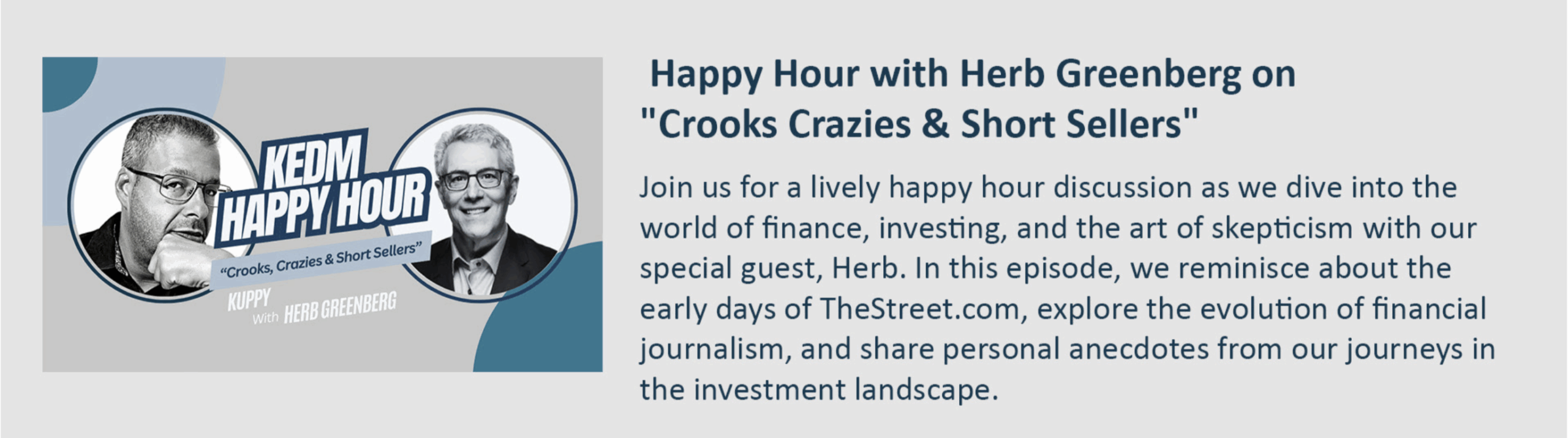
MEDIA APPEARANCES BY BSDs
Bessent Spoke With Druckenmiller After Mentor Criticized Him
- Treasury Secretary Scott Bessent said he spoke with Stanley Druckenmiller after his former mentor criticized his recent bond-market intervention, and touted that Treasuries might have outperformed because of that same action.
- “Stan’s a great investor. He changes his mind a lot, and he doesn’t like losing money. I think he lost money the day he sent in the editorial,” Bessent said on CNBC Monday of the billionaire investor’s stinging critique in the Wall Street Journal.
Power, Betrayal and the Fall of Leon Black
- When Leon Black, the founder of the financial behemoth Apollo Global Management, announced his retirement as CEO in January 2021, he was hoping for a clean succession.
- He said he would leave the position by his 70th birthday at the end of July and remain chairman of the board of directors and Apollo’s largest shareholder. Marc Rowan, one of the first employees at Apollo, would succeed him as CEO.
Activist investor Carl Icahn gives up JetBlue board seats
- Activist investor Carl Icahn has given up his board representation at JetBlue Airways (JBLU.O), opens new tab after sharply reducing a stake in the airline that he once called an attractive investment opportunity.
- In 2024, JetBlue agreed to appoint two members from Icahn’s firm to its board, Jesse Lynn and Steven Miller, under an agreement that also barred the Icahn group from conducting a proxy contest at the airline’s 2024 annual meeting.
